

Triple-O Review: Characters’ decisions and interactions made easy (and fun!)
A lightweight toolbox for any style of solo play

There is no shortage of tools and resources in the growing market of solo roleplaying. Between oracles, random generators, emulators, tables, and a lot more, Triple-O does something that I don’t think I’ve seen before (except maybe in UNE - Universal NPC Emulator, to an extent): instead of emulating a GM, it puts you, the solo player, in the role of the GM, and its goal is to simulate characters’ (and players’) decisions.
Cezar Capacle’s creations are always unique and lightweight, and this one is no different. When acting as the GM, you run a party of characters and generate their decisions based on their personalities, motivations, background, and other traits.
It’s an elegant concept that I found perfect for playing published adventures (you can check how I used it with The One Ring here). The zine states that it’s a great tool to playtest scenarios and improve your own GMing. While I didn’t test those, I can’t help but agree.
The Premise
The core mechanic is called the Triple-O Check, and it’s pretty simple. Whenever you want to let the characters act by themselves, you define 3 possibilities:
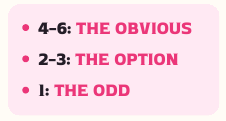
The Obvious: the action that best fits their established traits and personality.
The Option: a secondary choice that still makes sense.
The Odd: a surprising decision, unlikely but not impossible, that reveals another side of the character.
A d6 roll determines which O they take. Results 4-6 are Obvious. 2-3 are Option. 1 is the Odd.
These weighted probabilities (50% Obvious, 33% Option, 17% Odd) make things consistent, but with room for surprises. Like players at a table, most of the time they’ll act as expected, but every now and then comes a curveball that changes the session.
The surprises will come from your characters rather than scenes and random events, like when using, let’s say, Mythic. Actions you weren’t expecting can take a pre-written adventure to unusual places.
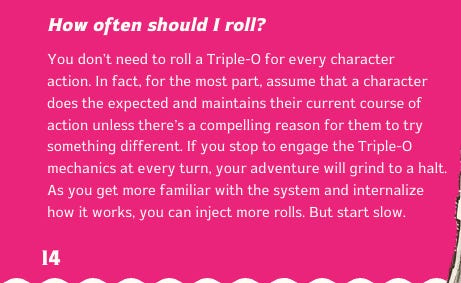
The amount of surprise and change is ultimately up to you. The more you use the Triple-O Check, the higher the probability of a wild action. Cezar warns that this might slow down your play, though.
But, again, that’s up to you. Maybe you don’t mind slowing the pace in exchange for more chaos and randomness!
Character vs Player Knowledge
I think it’s hard when playing solo to figure out if a character knows something that the player knows. That is something especially difficult when using published adventures. For me, the opposite is also a pain point, especially when writing or journaling: how to deal with something that I have no idea about, but the character likely knows?
Another tough one is trying to emulate proactive moments. Would the thief search for traps before opening the door? Would the sorcerer open the grimoire and leaf through it before stashing it? Would the fighter start with diplomacy before resorting to steel?
I find the Triple-O approach a great middle ground between intentionally playing the worst option or giving characters omniscience.
Come up with 3 different actions based on their traits and roll for it. This removes some bias during solo play and allows characters to act naturally, with plenty of room for surprises. It’s a fantastic way to deal with puzzles, for instance, and also traps, parts of exploration, social dynamics, etc. You can probably see how it’s going to fit into your games.
I love how many examples Cezar included to help with each mechanic. Most of them compound on each other, which is a bonus.
There are step by step guides on various aspects of the game, like:
Running a published adventure.
Managing companions and NPCs.
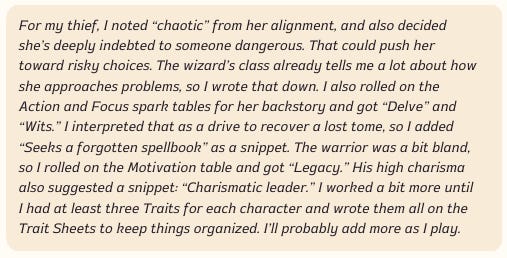
Generating the 3 Os.
Incorporating resources and current context to the actions, like wounds and temporary conditions.
Leaning on party actions instead of single characters.
Establishing interpersonal dynamics among party members.
Resolving specific situations like combat, downtime, and planning.
Using Triple-O as its own RPG system.
Random tables
Regarding two points above (generating the 3 Os and interpersonal dynamics), the zine has d66 spark tables designed specifically for that: Action, Focus, Method, Disposition, Motivation, and Dynamics.
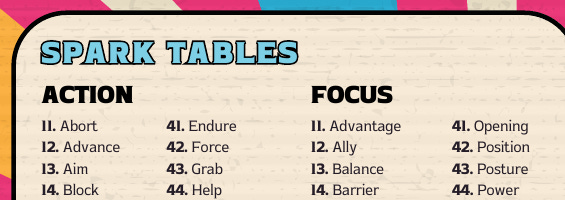
They are conveniently located as the front and back endpapers (the first and last pages of the book). Or, depending on how you print, the inside covers. The latter is how I did it. The tables are easily accessible on the first and last pages of the zine.
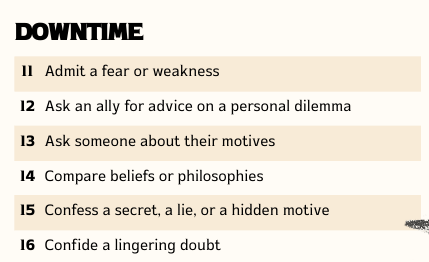
Later chapters expand that toolbox further with focused d66 tables for Combat, Exploration, Social Encounters, Downtime, Planning, Interpretation, and Dungeon Delving, making the book useful even outside its primary premise.
Doubling down and character growth
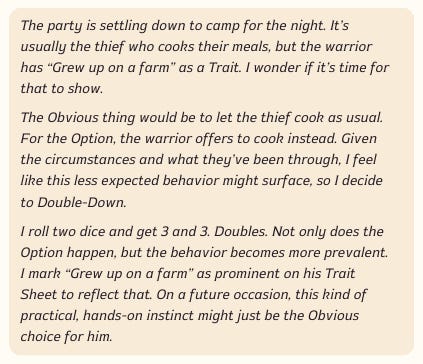
A clever mechanic is the Double-Down. Whenever doubles are rolled, the behavior associated with the result becomes more prevalent.
So during play, a warrior can slowly become more strategic and careful rather than reckless. A thief can lose their edge and grow fearful, an insecure cleric can settle into a leadership role, etc.
It’s such a satisfying way to develop emergent storytelling and create interesting character arcs without any planning.
Final thoughts
Honestly, I think it’s a 10/10 tool. I loved it, and it only got better the more I used it.
The 55-page system is easy to learn, fast to use, lightweight, doesn’t get in the way even if you’re constantly leaning into it, and, best of all, makes you understand and develop your characters.
Even if you’re solo playing with a single character, using a more traditional GM emulator, Triple-O can be useful when you wish to ‘incorporate’ your hero and decide on a course of action. It can also make your life easier by ‘managing’ companions and NPCs.
There are examples for every concept, and the writing is conversational, brief, and clear.
Whatever your style of play, I believe that Triple-O is a double-down Obvious choice for your toolbox.
Thanks for reading! I hope this review makes you wanna give it a try.
Triple-O is available on Itch.
Cezar Capacle’s entire catalogue is also available on Itch.
Support the creator.
I ordered this yesterday and look forward to getting my copy!
I love Cezar’s stuff!